<?xml version="1.0" encoding="utf-8"?> 
<demoProblems>
	<paths>
		<enguide>https://www.ascendmath.com/student_experience/html5/pdf/6291SG.pdf</enguide>
		<esguide>https://www.ascendmath.com/student_experience/html5/pdf/6291ESP.pdf</esguide>
		<video>https://web29.streamhoster.com/ascendedu/6291.mp4</video>
		<caption>https://www.ascendmath.com/student_experience/html5/captions/6291cap.xml</caption>
		<!--<review>https://www.ascendmath.com/student_experience/3105/or3105.pdf</review>-->
	</paths> 
	<!-- Fill in the blank
	<practice>
		<problem><![CDATA[Find the cost of 12 loaves of bread if one loaf costs $1.49.]]></problem>
		<description> </description>
		<answerkey>17.88</answerkey>
		<videoPath>https://www.ascendmath.com/student_experience/html5/videos/3105_1.mp4</videoPath>
		<espAudio>https://www.ascendmath.com/student_experience/html5/esp_audio/3105_Q1.mp3</espAudio>
		<type>blank</type>
	</practice>
	-->
	<practice>
		<problem>A coin is tossed 60 times, and it lands on heads 35 times. Find the experimental probability of the coin landing on heads. Write your answer as a fraction in simplest form.</problem>
		<es_problem>Una moneda se laniza 60 veces, y aterriza en las cabezas 35 veces. Encuentra la probabilidad experimental de que la moneda aterrice en las cabezas. Escriba su respuesta como una fracción en la forma más simple.</es_problem>
		<answerkey>7/12</answerkey>
		<description> </description>
		<type>blank</type>
		<!--<videoPath>https://web29.streamhoster.com/ascendedu/4184_1.mp4</videoPath>-->
		<!--<espAudio>https://www.ascendmath.com/student_experience/html5/esp_audio/3105_Q4.mp3</espAudio>-->
	</practice>
	<practice>
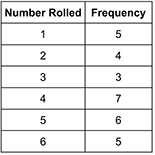
		<problem><![CDATA[A number cube with the numbers 1-6 is rolled 30 times. The table shows the frequency in which each number was rolled. What is the theoretical probability of rolling a 3? Write your answer as a fraction in simplest form.</br></br><img src="../expGR/6291_pract_2.jpg">]]>
		</problem>
		<es_problem>Un cubo de números con los números 1-6 se enrolla 30 veces. La tabla muestra la frecuencia con la que se rodó cada número. ¿Cuál es la probabilidad teórica de rodar un 3? Escriba su respuesta como una fracción en la forma más simple.</es_problem>
		<answerkey>1//6</answerkey>
		<description> </description>
		<type>choice</type>
		<answers>1//6, 3, 1, 1//10</answers>
		<!--<videoPath>https://web29.streamhoster.com/ascendedu/4184_2.mp4</videoPath>-->
		<!--<espAudio>https://www.ascendmath.com/student_experience/html5/esp_audio/3105_Q4.mp3</espAudio>-->
	</practice>
	<practice>
		<problem><![CDATA[A number cube with the numbers 1-6 is rolled 30 times. The table shows the frequency in which each number was rolled. What is the relative frequency of rolling a number greater than 4? Write your answer as a fraction in simplest form.</br></br><img src="../expGR/6291_pract_2.jpg">]]>
		</problem>
		<es_problem>Un cubo de números con los números 1-6 se enrolla 30 veces. La tabla muestra la frecuencia con la que se rodó cada número. ¿Cuál es la frecuencia relativa de rodar un número mayor que 4? Escriba su respuesta como una fracción en la forma más simple.</es_problem>
		<answerkey>11/30</answerkey>
		<description> </description>
		<type>blank</type>
		<!--<answers>0.0146 hectoliters, 1.16 deciliters, 0.146 hectoliters, 146 deciliters</answers>-->
		<!--<videoPath>https://web29.streamhoster.com/ascendedu/4184_3.mp4</videoPath>-->
		<!--<espAudio>https://www.ascendmath.com/student_experience/html5/esp_audio/3105_Q4.mp3</espAudio>-->
	</practice>
	<practice>
		<problem><![CDATA[A bag contains 10 shapes, 4 green squares, 3 red hearts, 2 blue triangles, and 1 yellow star. What is the theoretical probability of choosing a red heart? Express your answer as a decimal.</br></br><img src="../expGR/6291_9fix.jpg">]]>
		</problem>
		<es_problem>Una bolsa contiene 10 formas, 4 cuadrados verdes, 3 corazones rojos, 2 triángulos azules y 1 estrella amarilla. ¿Cuál es la probabilidad teórica de elegir un corazón rojo? Exprese su respuesta como un decimal.</es_problem>
		<answerkey>0.3</answerkey>
		<description> </description>
		<type>choice</type>
		<answers>2, 0.2, 0.3, 3</answers>
		<!--<videoPath>https://web29.streamhoster.com/ascendedu/4184_4.mp4</videoPath>-->
		<!--<espAudio>https://www.ascendmath.com/student_experience/html5/esp_audio/3105_Q4.mp3</espAudio>-->
	</practice>
	<practice>
		<problem><![CDATA[A bag contains 10 shapes, 4 green squares, 3 red hearts, 2 blue triangles, and 1 yellow star. What is the theoretical probability of choosing a green square? Express your answer as a percent.</br></br><img src="../expGR/6291_9fix.jpg">]]>
		</problem>
		<es_problem>Una bolsa contiene 10 formas, 4 cuadrados verdes, 3 corazones rojos, 2 triángulos azules y 1 estrella amarilla. ¿Cuál es la probabilidad teórica de elegir un cuadrado verde? Exprese su respuesta como un porcentaje.</es_problem>
		<answerkey>40%</answerkey>
		<description> </description>
		<type>choice</type>
		<answers>40%, 4%, 3%, 30%</answers>
		<!--<videoPath>https://web29.streamhoster.com/ascendedu/4184_5.mp4</videoPath>-->
		<!--<espAudio>https://www.ascendmath.com/student_experience/html5/esp_audio/3105_Q4.mp3</espAudio>-->
	</practice>
	<post>
		<problem>A coin is tossed 50 times, and it lands on tails 27 times. Find the experimental probability of the coin landing on tails. Write your answer as a decimal.</problem>
		<es_problem>Una moneda se lacha 50 veces, y aterriza en las colas 27 veces. Encuentra la probabilidad experimental de que la moneda aterrice en las colas. Escriba su respuesta como un decimal.</es_problem>
		<answerkey>0.54</answerkey>
		<type>choice</type>
		<description> </description>
		<answers>0.27, 0.54, 54, 27</answers>
	</post>
	<post>
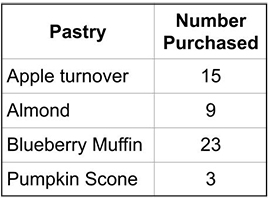
		<problem><![CDATA[	The table shows the types of pastries that customers bought one morning from Tia's Treats. If 150 customers buy pastries tomorrow, about how many would you expect to buy almond flavored pastries?</br></br><img src="../expGR/6291_1.jpg">]]>
		</problem>
		<es_problem>La tabla muestra los tipos de pasteles que los clientes compraron una mañana de Tia's Treats. Si 150 clientes compran pasteles mañana, ¿cuántos esperaría comprar pasteles con sabor a almendra?</es_problem>
		<answerkey>27</answerkey>
		<type>choice</type>
		<description> </description>
		<answers>27, 18, 9, 36</answers>
	</post>
	<post>
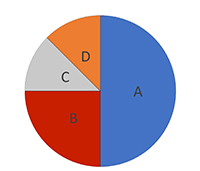
		<problem><![CDATA[	The spinner below has 4 parts, each containing a letter. Letter A is 1/2 of the circle, B is 1/4 of the circle, and C and D are each 1/8 of the circle. Ben spun the spinner 50 times and landed on the letter B 15 times. Is the experimental probability greater than or less than the theoretical probability of landing on the letter B? Answer greater than or less than.</br></br><img src="../expGR/6291_23.jpg">]]>
		</problem>
		<es_problem>El spinner a continuación tiene 4 partes, cada una con una letra. La letra A es 1/2 del círculo, B es 1/4 del círculo, y C y D son cada 1/8 del círculo. Ben giró el spinner 50 veces y aterrizó en la letra B 15 veces. ¿Es la probabilidad experimental mayor o menor que la probabilidad teórica de aterrizar en la letra B? Respuesta mayor o menor que.</es_problem>
		<answerkey>greater than</answerkey>
		<type>blank</type>
		<description> </description>
		<!--<answers>Gram, Meter, Celsius, Liter</answers>-->
	</post>
	<post>
		<problem><![CDATA[A bag contains 10 shapes, 4 green squares, 3 red hearts, 2 blue triangles, and 1 yellow star.  If you continue to choose shapes 50 times, putting back the chosen shape each time, about how many times would you expect to choose a green square?</br></br><img src="../expGR/6291_9fix.jpg">]]>
		</problem>
		<es_problem>Una bolsa contiene 10 formas, 4 cuadrados verdes, 3 corazones rojos, 2 triángulos azules y 1 estrella amarilla.  Si continúas elegiendo formas 50 veces, volviendo a poner la forma elegida cada vez, ¿cuántas veces esperarías elegir un cuadrado verde?</es_problem>
		<answerkey>20</answerkey>
		<type>choice</type>
		<description> </description>
		<answers>40, 20, 2, 4</answers>
	</post>
	<post>
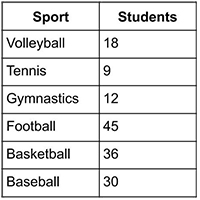
		<problem><![CDATA[Newtown High School is purchasing equipment for its athletic department for the next school year. In order to determine how much equipment is needed, the athletic director randomly surveys 150 students who plan to participate in athletics next year. The table shows the results. Based on the results below, if 540 total students plan to participate in sports next year, about how many basketball uniforms should the director purchase?</br></br><img src="../expGR/6291_13.jpg">]]>
		</problem>
		<es_problem>Newtown High School está comprando equipos para su departamento de atletismo para el próximo año escolar. Con el fin de determinar cuánto equipo se necesita, el director deportivo encuesta al azar a 150 estudiantes que planean participar en el atletismo el próximo año. La tabla muestra los resultados. Según los resultados a continuación, si un total de 540 estudiantes planean participar en deportes el próximo año, ¿cuántos uniformes de baloncesto debe comprar el director?</es_problem>
		<answerkey>130</answerkey>
		<type>choice</type>
		<description> </description>
		<answers>144, 36, 72, 130</answers>
	</post>
</demoProblems>